
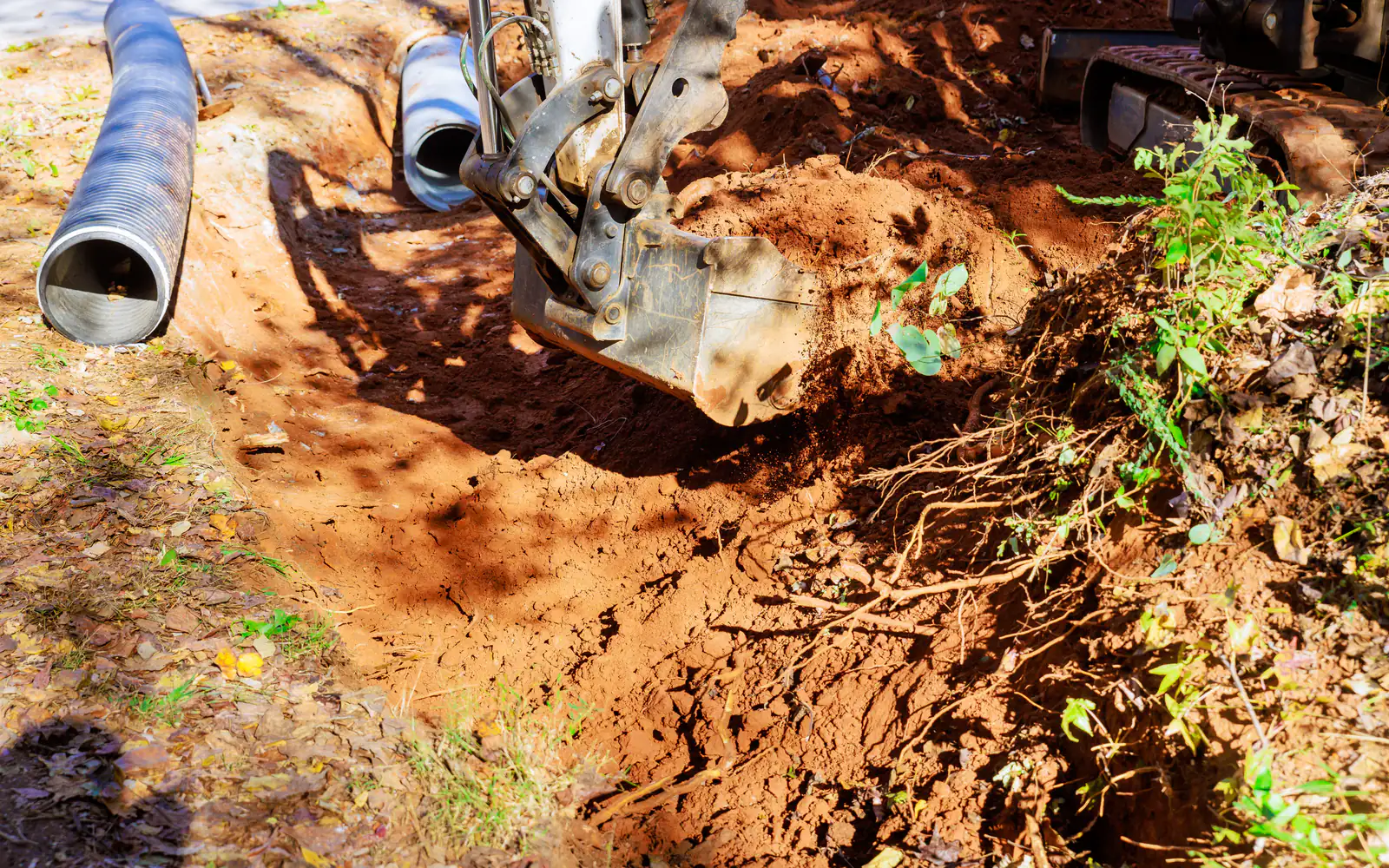
Trench Excavation in Cincinnati, OH
A trench is only as good as its fall.
Drain lines, downspout lines, ditches and swales, dug with a Kubota mini excavator and checked for grade the whole way, so the water actually leaves.
Trenching and drainage excavation is simple to describe and easy to get wrong. A trench has to start where the water collects, end somewhere lower, and fall steadily the whole way between. Miss the fall by a little and you've built a long, skinny puddle underground.
Brushcutrs digs drainage trenches with a Kubota mini excavator, the right size for yards, barn lots and field edges. We bid the job and run the machine ourselves, and a lot of our trenching gets added to a clearing job once the brush is gone and the wet ground shows itself.
What we dig trenches for
Most drainage trenching on homes and farms falls into a handful of jobs. They all share the same goal: catch water where it's causing trouble and carry it somewhere it isn't.
- Downspout lines that carry roof water away from the foundation
- Drain lines from a wet spot in the yard out to a lower outlet
- Trenches for French drains and curtain drains
- Open drainage ditches along a gravel drive or field edge
- Swale cutting to steer surface water around a house, barn or pasture
- Re-opening old ditches that filled in under years of brush
If we're already there doing it and they want us to do whatever, we'll do it.
Brushcutrs owner
Getting the grade right so water keeps moving
Water only runs downhill if the bottom of the trench does. On a flat backyard that can mean the trench gets deeper as it goes so the pipe keeps falling toward the outlet. On a hillside the fall comes easy, and the job is keeping the water slow enough that it doesn't scour.
We check grade as we dig instead of eyeballing it at the end. Where the pipe comes out matters just as much, so before the first bucket of dirt comes out we pick the outlet: a lower corner of the property, an existing ditch, or a spot where the line can daylight onto the ground without washing anything out.
Drainage ditches and swale cutting
Not every water problem needs a pipe. A ditch is an open channel, usually along a driveway, a fence line or a field edge, that gives runoff a set path to follow. A swale is its gentler cousin: wide, shallow and grassed over, so you can mow it and drive across it while it quietly moves water where you want it.
Swale cutting is a good fit for pastures and big yards where water sheets across the ground after a hard rain. We shape the swale with the mini excavator, then grade the edges so it blends into the yard instead of looking like a scar.
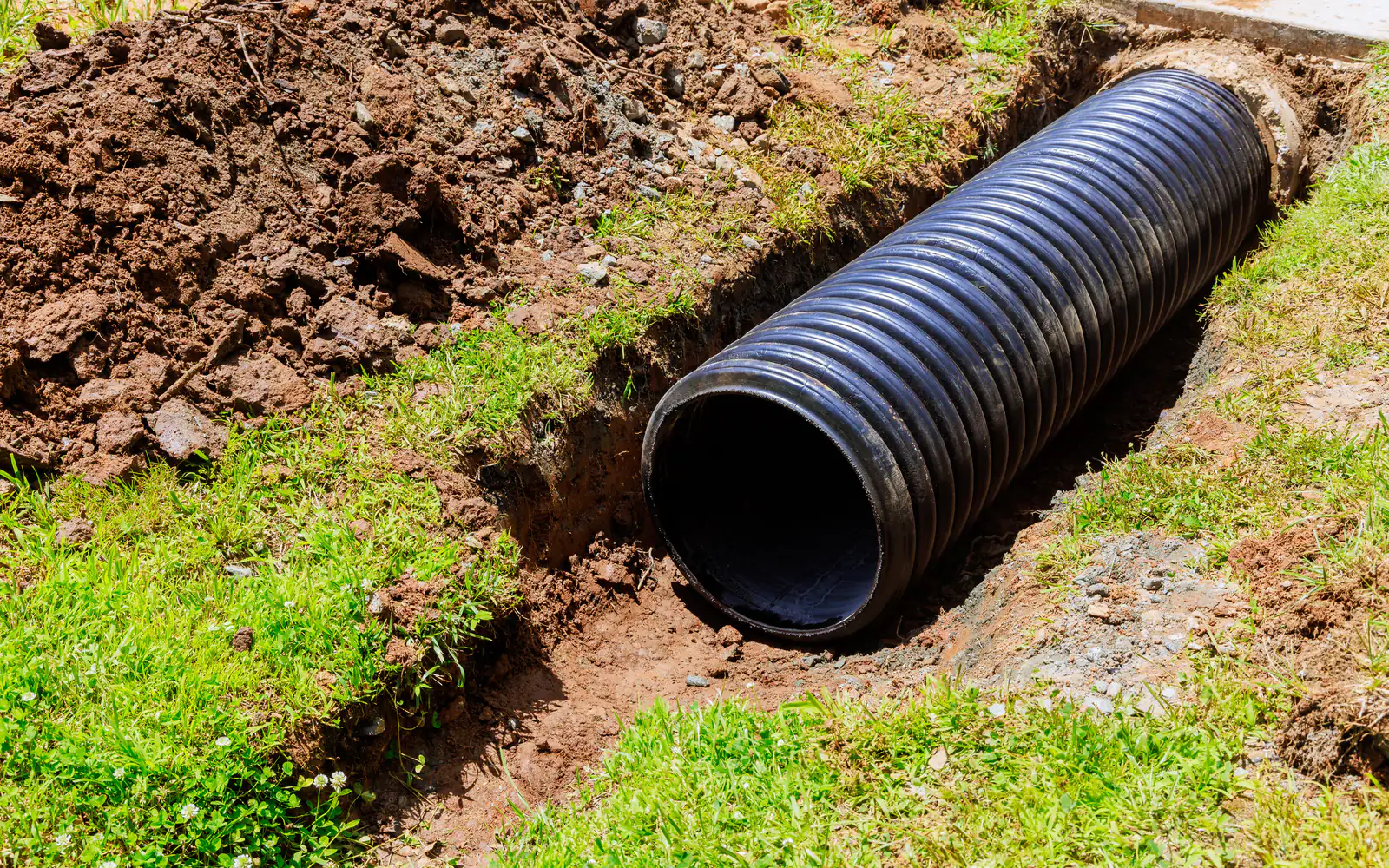
Trenching in Ohio Valley clay
Most ground around here is heavy, clay-rich glacial till on the uplands and silty bottomland near the rivers. Clay holds water, drains slowly and gets slick and sticky when it's wet. That's exactly why so many properties in the area need drainage, and it changes how the digging goes.
Clay trenches hold their walls well when the ground is firm, which helps. Dug in soaked ground, though, the bucket smears the trench sides and the machine leaves ruts across the yard. We plan around the weather where we can, and we keep the spoil pile where it can go straight back in once the pipe and gravel are set.
Before the bucket goes in the ground
Utility lines get marked before anyone digs, through Ohio 811 on the north side of the river and Kentucky 811 on the south. We also ask about the private lines that service doesn't cover: the water line to the barn, the electric to a detached garage, the septic field. Walking the route together before the job saves a lot of trouble.
Where we do trenching work
Our base is North Bend, just west of Cincinnati, and our favorite ground is Northern Kentucky: Florence, Union, Burlington, Walton and the rolling farm country of Boone County, plus Kenton and Campbell counties. We trench across Cincinnati and its hilly west side, into Southeast Indiana around Lawrenceburg and Aurora, and as far as Lexington, KY when it pairs with a bigger job.
Trenching is one piece of our light excavation work. If the trench is for a gravel-and-pipe drain, see French drain installation. If the brush has to come out first, our lot clearing gets the ground open.
Goes well with
- French drain installation: French drains and curtain drains with fabric, washed gravel, perforated pipe and a real outlet, built for heavy clay ground.
- Yard drainage solutions: Fixes for standing water, soggy low spots, water at the foundation or barn, hillside washouts and muddy gates.
- All light excavation services
What people call us for
Common trenching and drainage excavation projects
Downspout line to daylight
A buried line from the gutters to a lower spot in the yard, so roof water stops pooling against the foundation.
Ditch along a gravel drive
An open ditch that catches runoff before it crosses the driveway and carries gravel downhill with it.
Swale behind a barn
A shallow, grassed channel cut uphill of a barn so rain off the hillside goes around the building instead of through the doors.
Drain line from a wet spot
A trench and pipe from the spot that never dries out to an outlet at the low edge of the property.
Re-opening an old ditch
A farm ditch buried under brush and silt gets dug back out after clearing, so it does its job again.
Questions
Trenching and drainage excavation questions
How deep does a drainage trench need to be?
It depends on what the trench is for and where the outlet sits. A downspout line can run fairly shallow, while a drain meant to catch groundwater has to reach the wet layer. The real rule is that the bottom has to keep falling toward the outlet, so depth often changes along the run.
What's the difference between a drainage ditch and a swale?
A ditch is a narrower open channel with steeper sides, usually along a drive or field edge. A swale is wide and shallow with gentle sides, grassed over so you can mow and drive across it. Both move surface water, but a swale fits better in a yard.
Can you trench when the ground is wet?
Sometimes, but wet clay smears, ruts and makes a mess of the yard. We'd rather wait for the ground to firm up a little when the schedule allows. If water is causing damage now, we'll talk through the best way to get in.
Do you backfill and clean up the trench?
Yes. The spoil goes back in once the pipe or gravel is set, and we grade the top so it settles evenly. Freshly backfilled trenches can sink a little after the first few rains, which is normal in clay.
What drives the price of trenching?
Length, depth, the ground itself, any pipe or gravel that goes in, and how far the outlet is from the problem. Access matters too, like gates, fences and slopes. We price by the job after walking the route, so the estimate covers the whole trench.
Where we do trenching and drainage excavation
Northern Kentucky first, then Greater Cincinnati, Southeast Indiana and out to Hamilton, Lexington and Georgetown, KY.
Ready to get that ground cleared?
Call or text us, or send the form. We'll walk the ground with you and give you one price for the job.