
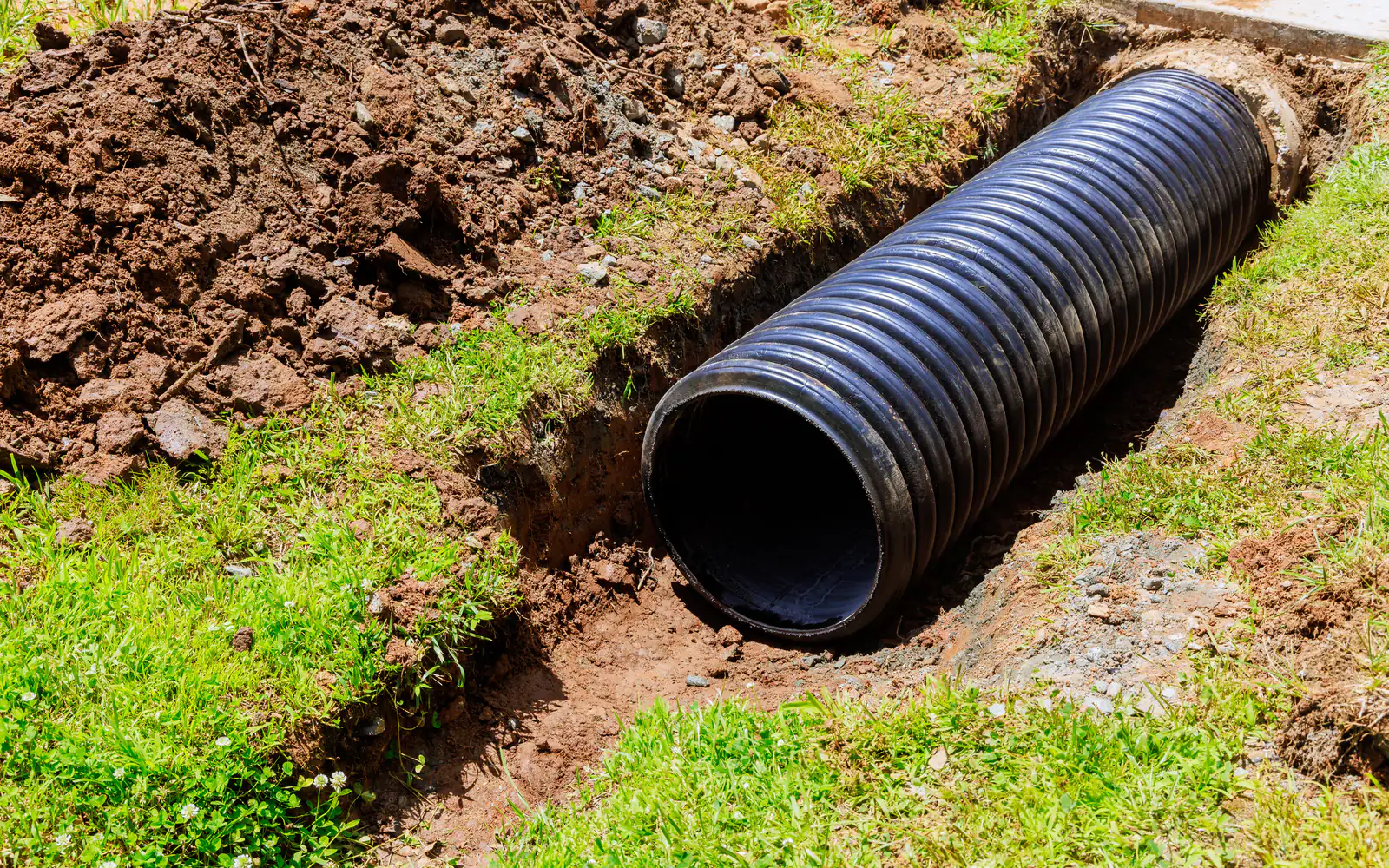
French Drain Installation in Cincinnati, OH
Gravel, pipe and somewhere for the water to go.
French drains and curtain drains that catch groundwater on clay ground and carry it around your house, barn or yard to a proper outlet.
French drain installation is one of the most useful small digging jobs on a wet property. Done right, it quietly pulls water out of the ground and sends it somewhere harmless. Done wrong, with no outlet or no fabric, it fills with silt and turns into a buried bathtub.
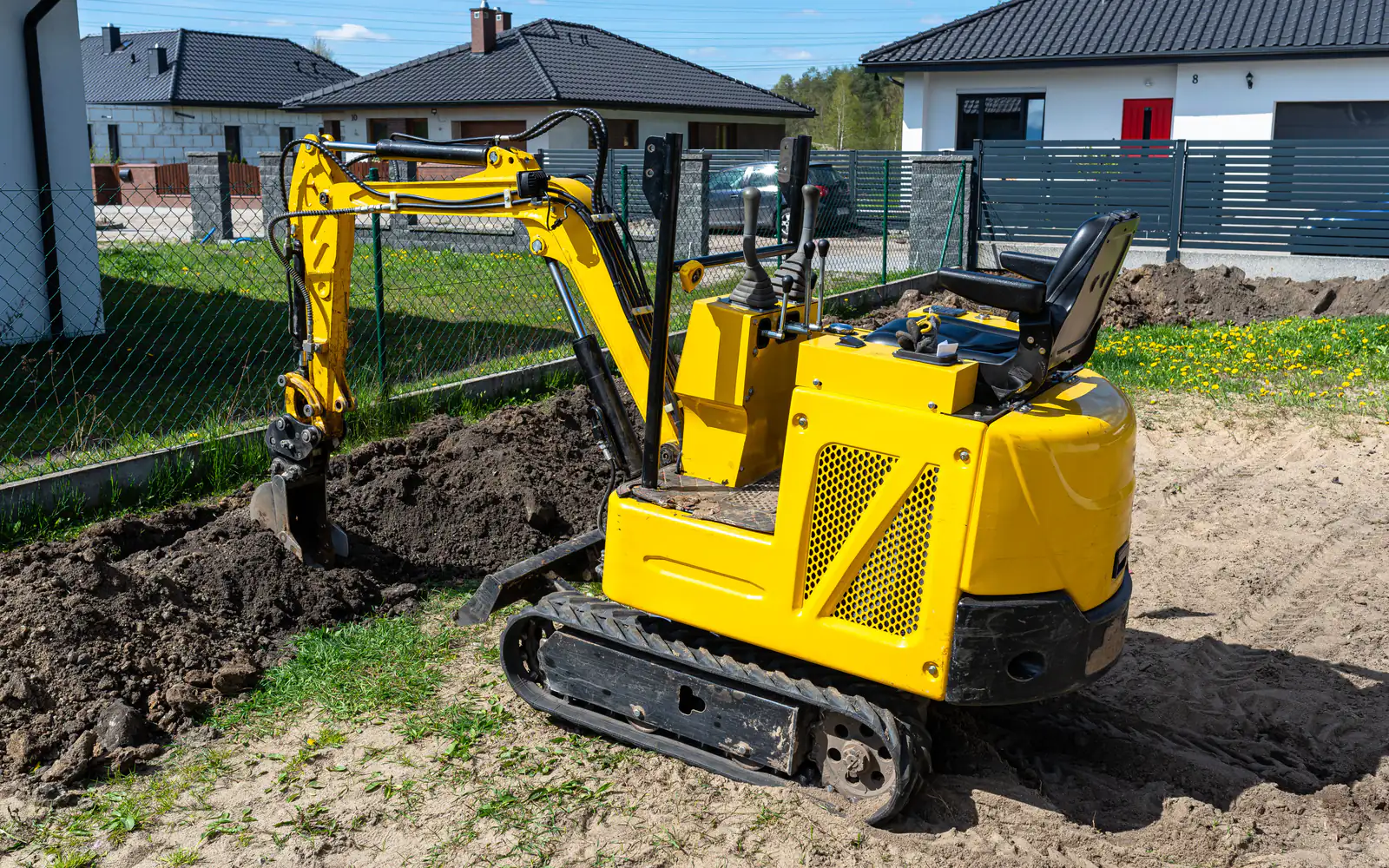
Brushcutrs digs French drains with a Kubota mini excavator, which fits behind houses and along barn walls where a bigger machine can't go. A lot of our drain work happens right after we clear a property, once the overgrowth is gone and you can see where the water has been sitting all along.
How a French drain is built
There's nothing fancy about a French drain. It's a few honest materials put together in the right order, in a trench dug to the right grade.
- A trench that falls steadily from the wet area to the outlet
- Filter fabric lining the trench to keep clay and silt out of the stone
- A bed of washed gravel in the bottom
- Perforated pipe laid on the gravel, holes placed to collect water
- More washed gravel over the pipe, with the fabric wrapped over the top
- An outlet at the low end where the collected water leaves
If we're already there doing it and they want us to do whatever, we'll do it.
Brushcutrs owner
Why so many French drains go in on Ohio Valley clay
Across Northern Kentucky and Greater Cincinnati the soil is mostly heavy, clay-rich glacial till, with silty bottomland near the rivers. Clay drains slowly. After a long rain the water can't sink in, so it sits near the surface or creeps sideways downhill along the top of the denser layer.
That sideways water is what keeps a side yard spongy for a week, makes a basement wall damp, or turns a barn aisle to mud. A French drain gives it an easier path than the one it's taking now. The gravel and pipe move water far faster than the clay around them, so the water goes where the drain sends it.
Curtain drains uphill of a house or barn
On hillside lots, which describes a lot of Northern Kentucky and the west side of Cincinnati, the trouble often isn't rain falling on the yard. It's water moving down the slope underground from the ground above you. A curtain drain is a French drain set across the slope, uphill of the house, barn or outbuilding, to catch that water before it gets there.
Curtain drain installation is common on newer home sites around Union and Burlington, where houses are cut into wooded hillsides. It works just as well above a horse barn or run-in shed where the stalls stay wet no matter how much bedding you throw at them.
Where the water goes
The outlet is the part people forget, and it's the part that decides whether the drain works. Collected water needs a lower place to go: a spot where the pipe can daylight onto the ground, an existing ditch, or a swale that carries it further. Where the ground is too flat to daylight, the pipe can end in a pop-up emitter at the low point of the yard.
We plan the outlet before we dig, and we keep the water on your own property rather than dumping it on the neighbor's. If there's no good place for the water to go, we'll tell you that up front instead of burying pipe that has nowhere to drain.
Signs you need a French drain
Not every wet yard needs a buried drain. Some just need a little regrading. These are the signs that point toward a French drain or curtain drain:
- Ground that stays soggy for days after the rain has stopped
- Water seeping out of a hillside or at the base of a slope
- A damp basement wall on the uphill side of the house
- A barn or run-in shed that stays muddy inside
- Moss, rushes or cattails growing where grass used to be
Where we install French drains
We work out of North Bend, just west of Cincinnati, with Northern Kentucky at the top of the list: Florence, Union, Burlington, Hebron, Fort Thomas, Alexandria and the farm ground across Boone, Kenton and Campbell counties. We install drains across Cincinnati, up toward Hamilton, OH, and into Southeast Indiana around Lawrenceburg and Aurora.
French drains are one part of our light excavation work. For open ditches and drain lines, see trenching and drainage excavation. If the wet spot is buried under a thicket, our residential land clearing opens it up first.
Goes well with
- Trenching and drainage excavation: Trenches for drain and downspout lines, drainage ditches and swale cutting, dug with the right fall through heavy clay.
- Yard drainage solutions: Fixes for standing water, soggy low spots, water at the foundation or barn, hillside washouts and muddy gates.
- All light excavation services
What people call us for
Common french drain installation projects
Curtain drain above a hillside home
A drain cut across the slope uphill of the house to catch groundwater before it reaches the foundation.
French drain along a barn wall
Gravel and pipe set along the uphill side of a barn so the aisle and stalls stop staying wet.
Soggy side yard
A drain down the narrow strip between two houses that never dries out, carried to an outlet at the low end.
Wet spot at the bottom of a slope
A drain at the foot of a hill where seep water surfaces and keeps the lawn spongy all spring.
Drain after a clearing job
Once a thicket comes out and the hidden wet ground shows, a French drain goes in before the yard gets seeded.
Questions
French drain installation questions
Does a French drain need an outlet?
Yes. A French drain collects water, but it has to send that water somewhere lower, like a daylight outlet, a ditch or a pop-up emitter. Without an outlet, the trench fills and holds water instead of moving it.
What's the difference between a French drain and a curtain drain?
They're built the same way, with a trench, fabric, washed gravel and perforated pipe. A curtain drain is a French drain placed across a slope, uphill of whatever you're protecting, to intercept groundwater moving downhill. The name describes where it goes, not how it's made.
Will a French drain fix a wet basement?
It can help a lot when the water is coming through the ground from outside, especially on the uphill side of the house. Basement moisture can also come from cracks, gutters or the grade around the foundation, so we look at the whole picture first. We'll tell you honestly what a drain can and can't do for your situation.
How long does a French drain last?
A drain built with filter fabric, washed gravel and a good outlet can work for many years. The usual cause of failure is silt working into the stone, which is what the fabric prevents. Keeping the outlet clear of leaves and debris helps it keep running.
What affects French drain cost?
The length of the drain, how deep it has to go, the amount of gravel and pipe, and how far the outlet is from the wet area. Access behind houses and fences plays in too. We price the whole drain by the job after walking it with you.
Where we do french drain installation
Northern Kentucky first, then Greater Cincinnati, Southeast Indiana and out to Hamilton, Lexington and Georgetown, KY.
Ready to get that ground cleared?
Call or text us, or send the form. We'll walk the ground with you and give you one price for the job.