
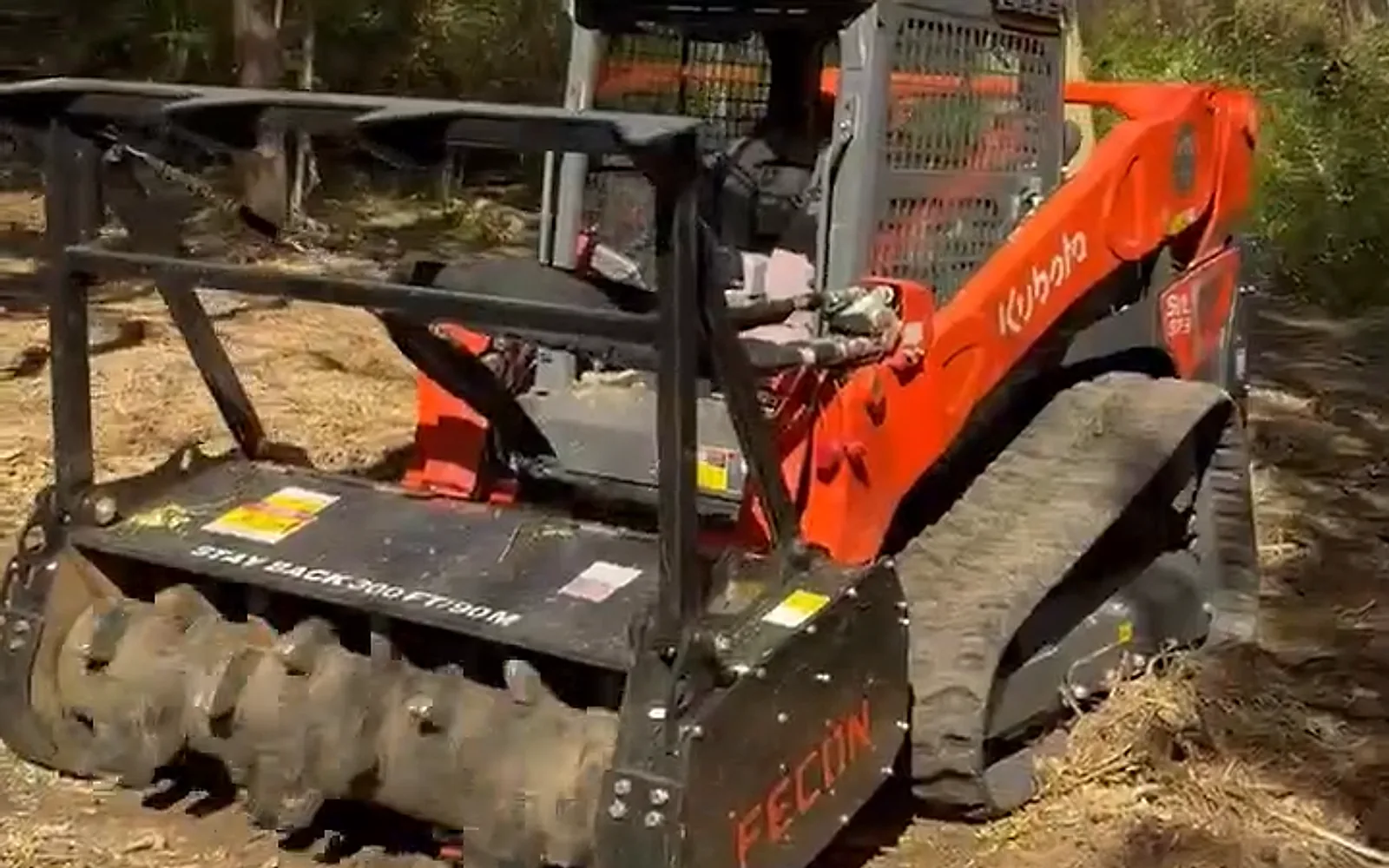
Forestry Mulching Services in Cincinnati, OH
No burn pile. No dump trailer. Just open ground.
We're family owned, and we run our own mulcher. We work out of North Bend, just west of Cincinnati, and spend most of our days across the river in Northern Kentucky.
Forestry mulching is the fastest honest way to turn a wall of brush into ground you can walk. We bring a Fecon mulching head on a Kubota compact track loader, drive it into the thicket, and grind honeysuckle, briars, saplings and small trees into a layer of mulch on the spot. Nothing gets piled, burned or hauled off.
We're a father and son outfit based in North Bend, Ohio, and Northern Kentucky is where we want to be. Boone, Kenton and Campbell County ground is steep, wooded and full of invasive brush, which is exactly the work this machine was built for. As the owner puts it: "We have the best equipment you can get. So he's pretty quick at it."
Forestry mulching: what we do
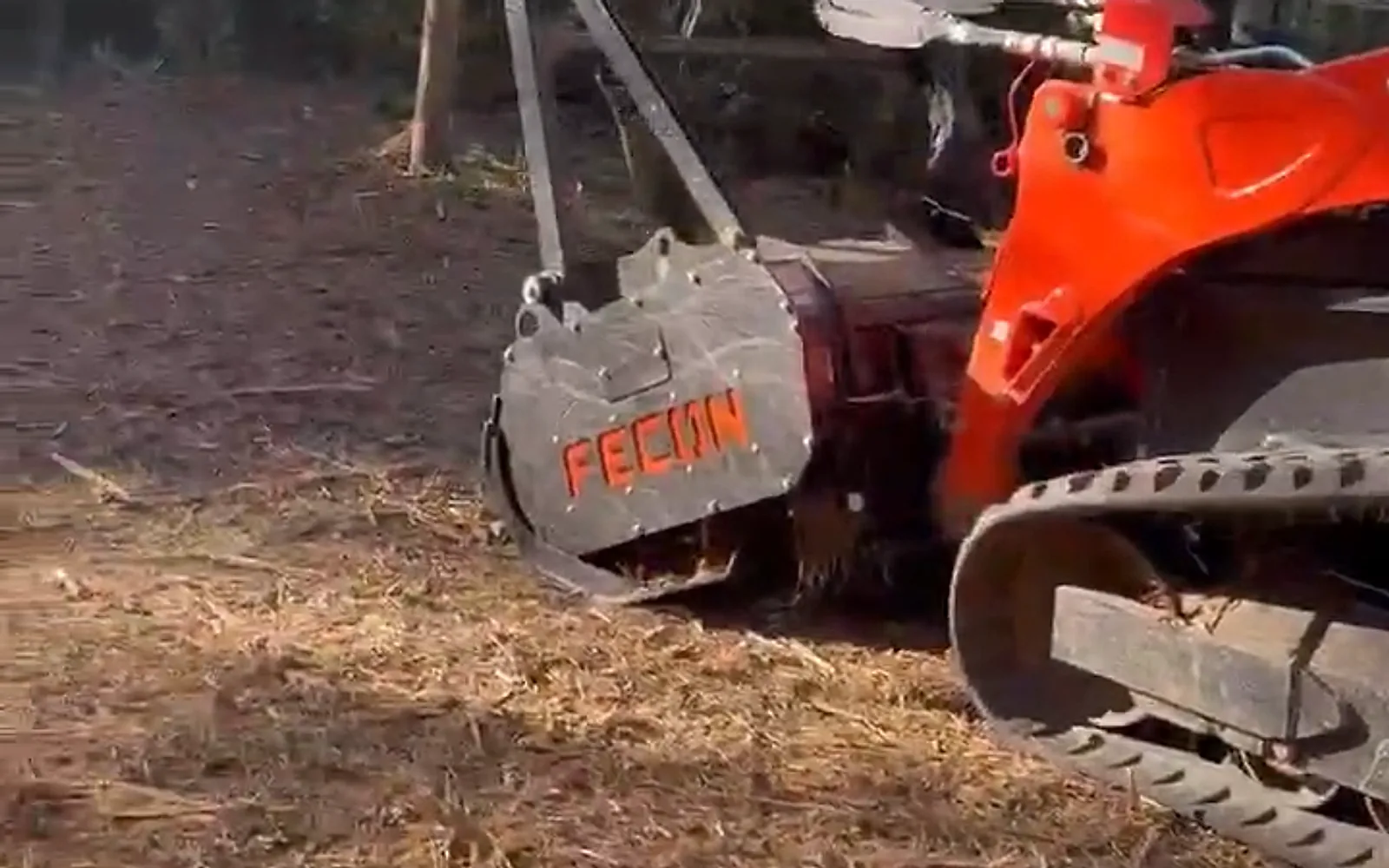
Brush mulching
Bush honeysuckle, multiflora rose, briars and saplings mulched out from under the trees you want to keep.
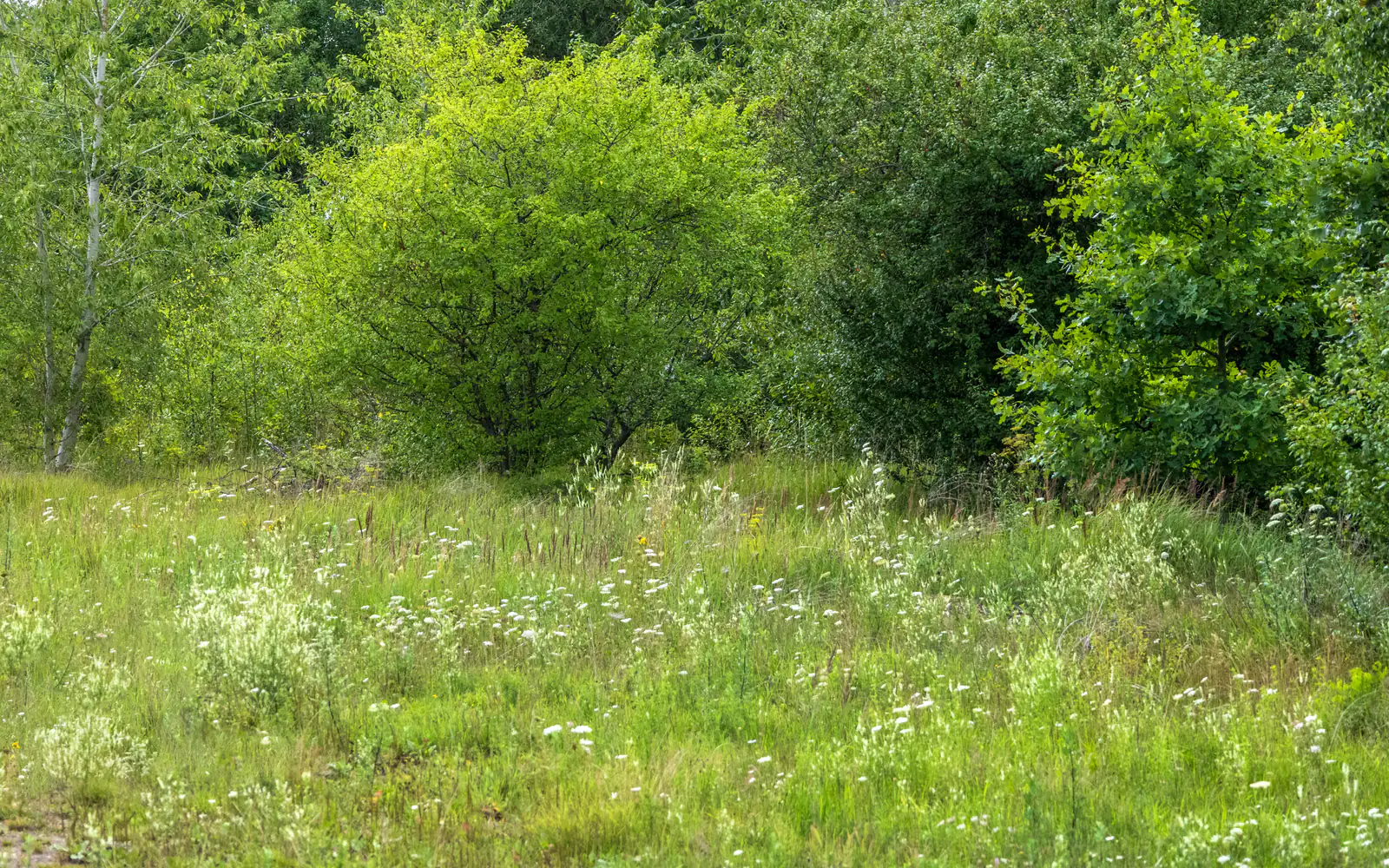
Forestry mulching for overgrown land
Old pasture and fields gone to cedar, brush and saplings, ground down and given back to horses, hay or hunting.
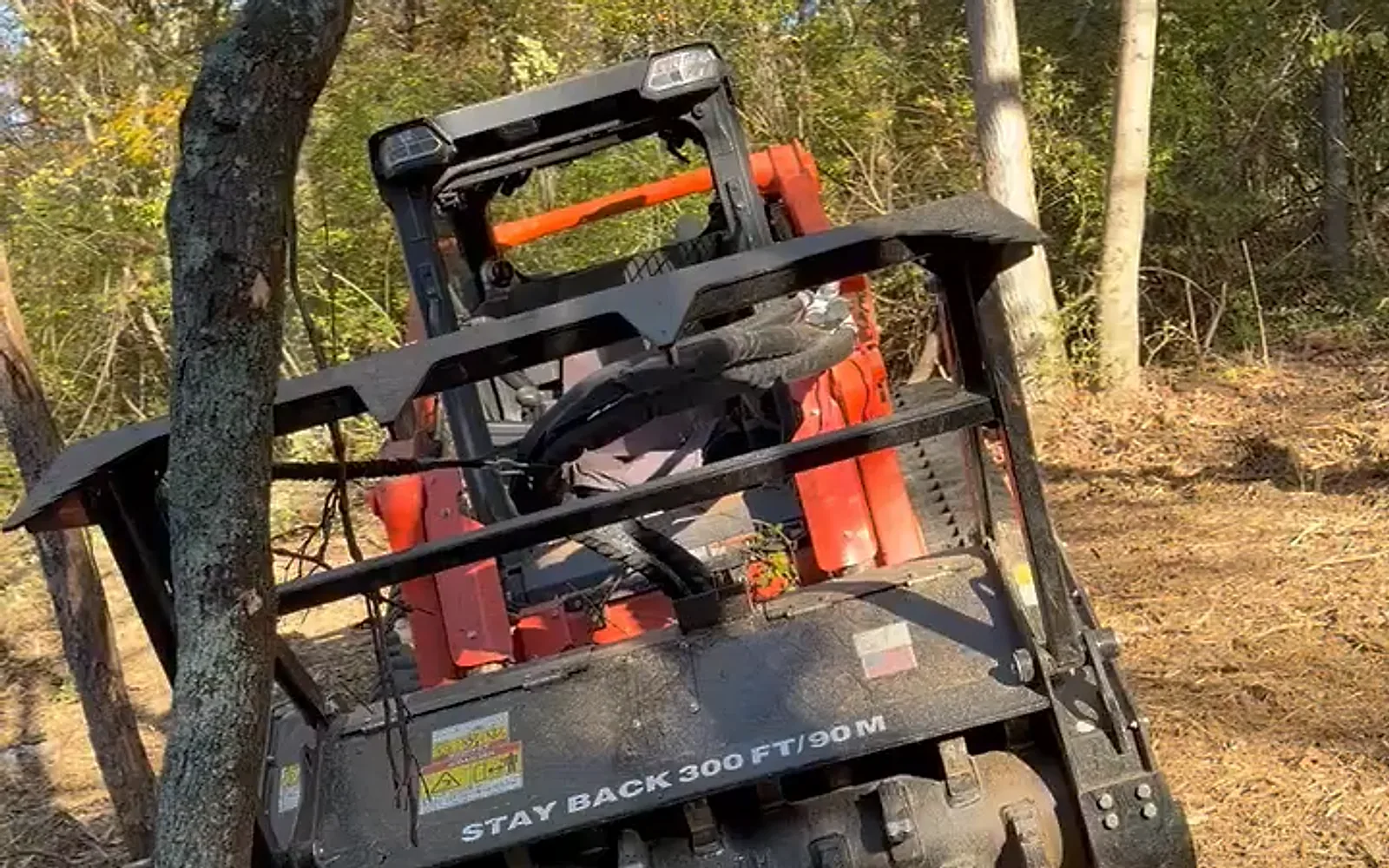
Brush clearing
Trails, fence lines, shooting lanes, creek access and driveway paths cut through brushy, wooded ground.
How a forestry mulcher works
The mulching head is a heavy steel drum lined with teeth, mounted on the front of a track loader. It spins fast enough to chew a standing sapling from the top down, and the operator walks it through brush the way you'd push a mower through tall grass. What comes out the back is shredded wood and leaf, spread across the ground where the brush used to be.
Cutting and cleanup happen in the same pass, so there's no second crew dragging brush to a pile. We run the machine ourselves.
For spots the loader shouldn't drive to, like a steep creek bank or the far side of a ditch, we also run a Fecon mulcher on an excavator arm. It reaches out and mulches from where the tracks can sit safely.
You take a wood, you can't even walk in. And then it's just all nice and clear.
Brushcutrs owner
Why mulching beats a dozer on hillside ground
A dozer clears by pushing. It rips the roots out, scrapes the topsoil and leaves you a pile of trees and dirt to burn or haul. On flat ground that might be fine. On the hillsides and ravines around Cincinnati and Northern Kentucky, bare clay with nothing holding it is a mudslide waiting for the next hard rain.
A mulcher cuts above ground and leaves the root systems in the soil. Those roots keep holding the bank while grass and groundcover come back, and the mulch on top slows runoff and keeps the surface from washing. Rubber tracks spread the machine's weight, so we can work slopes and soft, wet spots that would bog a wheeled machine or get torn up by a dozer.
- No brush piles smoking in the back field for a week
- Nothing to load up and haul to the dump
- Roots stay put to hold soil on slopes
- A mulch layer covers bare ground so it doesn't wash out
- Less rutting on soft clay and wet ground
Where forestry mulching fits, and where it doesn't
Mulching shines on brush, invasive shrubs, vines and small to mid-size trees. It's the right tool for opening up woods, reclaiming fields, cutting trails and clearing fence rows. It also handles stumps alongside a job: the mulcher head grinds them down while it's already working the ground.
It isn't the tool for everything. If you need a building pad stripped to bare dirt, roots and all, that's lot clearing, which takes different steps. Big hardwoods hanging over a house belong to a tree crew. We'll tell you straight on the walk-through which one your ground needs.
Our three kinds of forestry mulching work
Most jobs land in one of three buckets, and each one has its own page with the details.
- Brush mulching for thick underbrush, bush honeysuckle, multiflora rose and briar patches
- Forestry mulching for overgrown land when an old pasture or hayfield has gone to cedar, saplings and dead ash
- Brush clearing for trails, fence lines, shooting lanes and access into wooded ground
How a job goes, start to finish
Call or text and tell us what you've got. We come out, walk the ground with you and give you a free estimate priced by the job, not by the hour. In the owner's words: "I'm just going to do by the job, because that way if I get done in three hours, it doesn't matter."
On the day, we unload, mulch the area you marked and grind down the stumps in the way. You get the property back with a mulch layer on top and clean edges. If the job is bigger than brush, like opening up a whole lot or the acreage around a house, it falls under our land clearing work, and mulching is usually part of it. We work Monday to Friday, 8 AM to 5 PM.
Where we run the mulcher
We start from North Bend and cross the river most days. Florence, KY, Union, KY and Burlington, KY are a short drive, and new home sites on wooded Boone County lots keep the mulcher busy there. Our Northern Kentucky page has more on the area.
We also work all over Cincinnati, OH, up through Hamilton, OH, and west into Southeast Indiana around Lawrenceburg, IN and Aurora, IN. Bigger jobs take us down I-75 as far as Georgetown, KY and Lexington, KY.
What people call us for
Common forestry mulching projects
Honeysuckle-choked woods
Opening up a wood lot so you can walk it, see through it and use it again.
Old pasture gone to cedar
Grinding cedar, saplings and briars out of a field that hasn't been mowed in years.
Trails and shooting lanes
Cutting paths through timber for horses, ATVs, deer stands and hunting access.
Fence row cleanup
Clearing the brush and multiflora rose growing through a fence so it can be fixed or replaced.
Hillside brush
Clearing steep wooded slopes without tearing out the roots that hold them together.
Yard edge and view
Pushing the brush line back behind a house to win back the yard and the view.
Questions
Forestry mulching questions
How much does forestry mulching cost per acre?
We don't price by the acre or by the hour. We walk the ground and give you one price for the whole job, based on how thick the brush is, how big the trees are, the slope and how easy it is to get the machine in. The estimate is free, and the price is for the job, not the clock.
Do you grind stumps?
Only alongside a clearing or mulching job. We don't run a stump grinder; the mulcher head grinds stumps down while it's already working the area. If all you need is a stump or two ground out of a finished yard, a stump grinding service is the better call.
What happens to the mulch after the job?
It stays on the ground as a layer that protects the soil and breaks down over the next few seasons. On most ground that's a plus, since it holds moisture and slows erosion. Where the layer is thin, grass comes through sooner, so tell us if you want a spot back in lawn or pasture quickly.
Can a forestry mulcher work on steep or wet ground?
Usually, yes. A track loader spreads its weight wide, so it handles slopes and soft clay better than a dozer or a wheeled machine. Where it's too steep or too wet to drive, the excavator mulcher can reach in from solid ground.
What size trees can a forestry mulcher take down?
Brush, saplings and small trees are the everyday work, and the mulcher handles more than most people expect. Large hardwoods are a different job, and big dead trees near buildings belong to a tree crew. We'll tell you on the walk-through what the machine will take on your ground.
Where we do forestry mulching
Northern Kentucky first, then Greater Cincinnati, Southeast Indiana and out to Hamilton, Lexington and Georgetown, KY.
Ready to get it cleared?
Call or text us, or send the form. We'll walk the ground with you and give you one price for the job.