
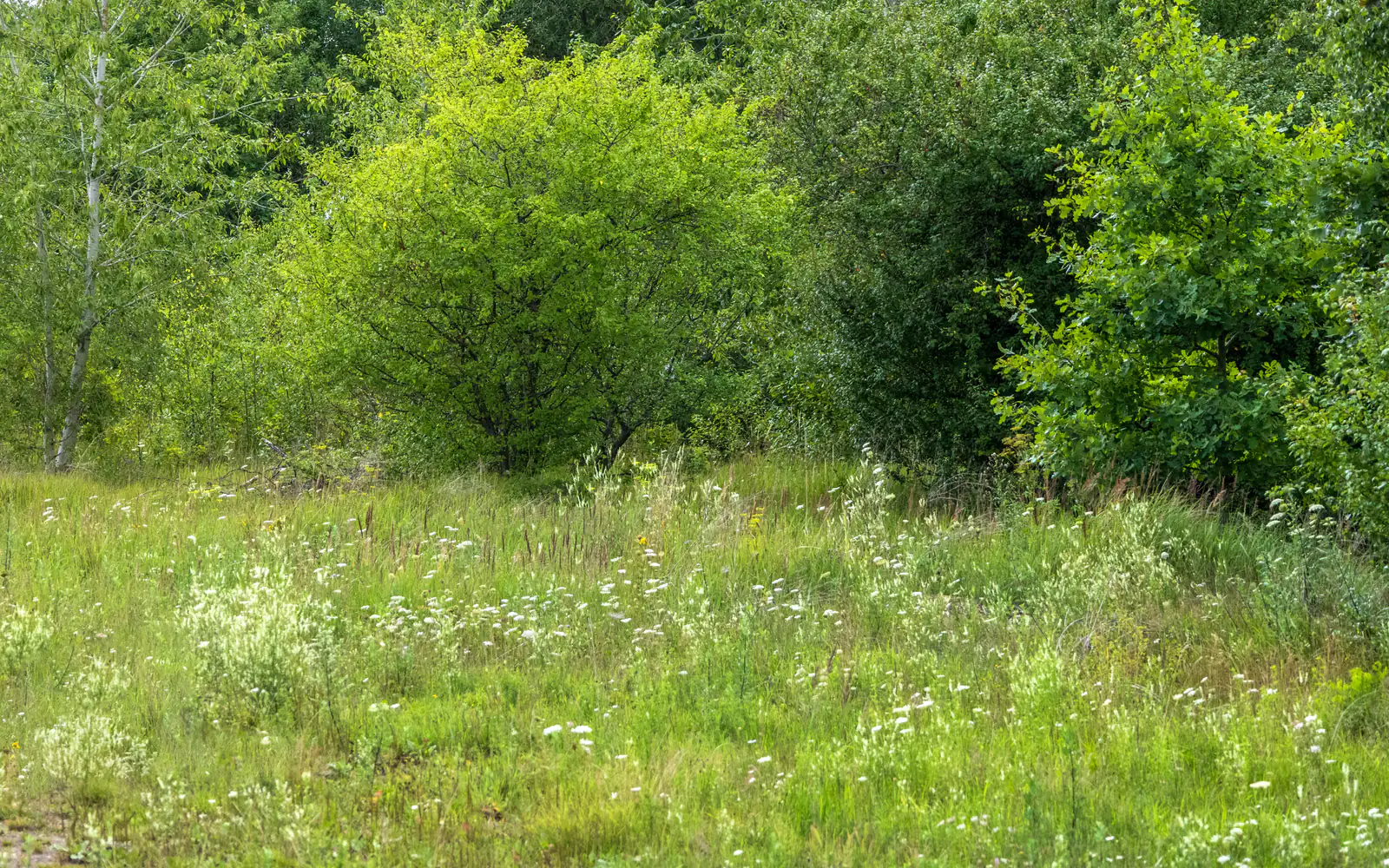
Overgrown Land Clearing in Cincinnati, OH
Those back acres are still yours.
Old pasture, hayfields and fence rows that went to cedar, briars and saplings. We grind it down and hand the ground back to you.
Forestry mulching for overgrown land is the quickest way to get a neglected field back. Leave a pasture unmowed for a few seasons around here and it fills with eastern red cedar, multiflora rose, autumn olive, briars and a crop of saplings. Our Fecon mulcher grinds all of it down to a mulch layer with the roots left in the ground, so you get the acres back without dozing the topsoil off.
The owner sees it on almost every walk-through: "A lot of people have a lot of land and they might have, you know, 20 acres of it or 10 acres of it that they don't even use. And then we open it all up and they can use it."
How a good field turns into a thicket
It starts small. A few cedars along the fence, some rose canes in the corner, briars where the mower couldn't reach. Without grazing or mowing, the brush fills in from the edges and the saplings follow. Give it a handful of years and a field you used to cut for hay is a thicket you can't drive a truck through.
Eastern red cedar is the big one on old Ohio Valley and Bluegrass pasture. It spreads fast, crowds out the grass and makes the ground useless for grazing. Autumn olive and multiflora rose are close behind.
You take a wood, you can't even walk in. And then it's just all nice and clear.
Brushcutrs owner
Clearing overgrown land without losing your topsoil
Pushing a field clear with a dozer scrapes the best soil into the pile along with the brush. On clay ground that topsoil took a long time to build, and once it's gone, grass struggles.
Mulching cuts everything at ground level and leaves the soil where it is. The mulch covers the surface, so the ground doesn't bake, crust or wash between the job and the next growing season. On rolling and hillside pasture, those old roots keep holding while new grass takes over.
Dead ash in the fence rows
Emerald ash borer has killed most of the ash trees across Ohio and Kentucky, and plenty of old fence rows are lined with them. Standing dead ash gets brittle. Limbs drop without warning and whole trees snap in a storm, which is a real problem over a fence or a riding path.
Smaller dead ash along a fence row or field edge comes down with the mulcher and gets ground up on site. Big dead ash leaning toward a house, barn or power line is a job for a tree crew, and we'll tell you so rather than gamble with it.
Reclaiming pasture for horses, hay or hunting
What the ground is for changes how we clear it, so tell us the plan up front.
- Horse pasture: brush and cedar out, stumps ground low so they aren't a trip hazard, and fence lines cleaned so you can run board or wire again.
- Hay ground: the field opened edge to edge, with the mulch spread thin enough for grass to come through.
- Hunting ground: the field opened up, with strips of cover left along the draws and edges where deer move.
- Unused acreage: the brush line pushed back to where the field used to end, so the whole property is walkable again.
What a reclaiming job looks like
We walk the field with you, mark what stays and give you a free estimate priced by the job. There's no per-acre meter running.
We work the field in passes, cedar, saplings, briars and all, and grind stumps low as we go. Fence rows get cleaned up so you can see the wire again. If you're opening up land around the house or barn too, our residential land clearing page covers that side, and a wet draw through the middle of the field is a good time to talk about trenching and drainage while the machines are already there.
Clearing land for pasture usually means seeding afterward. Mulch breaks down over time, and grass seed takes best where the layer is thin. For thick brush in the woods next to the field, see brush mulching.
Where we reclaim old fields
Boone County has plenty of farmland going back to brush, from the back roads outside Burlington, KY to the edges of Union, KY and Florence, KY where old farms meet new home sites. Start with our Northern Kentucky page.
We also reclaim pasture on the rural edges of Cincinnati, OH, in the Dearborn County hills of Southeast Indiana, and down in the horse country around Lexington, KY, where cedar keeps creeping into old board-fence pasture. Field jobs take us south into Scott County too, around Georgetown, KY.
Goes well with
- Brush mulching: Bush honeysuckle, multiflora rose, briars and saplings mulched out from under the trees you want to keep.
- Brush clearing: Trails, fence lines, shooting lanes, creek access and driveway paths cut through brushy, wooded ground.
- All forestry mulching services
What people call us for
Common forestry mulching for overgrown land projects
Cedar-choked pasture
Grinding out red cedar and briars so a field can be grazed again.
Old hayfield reclaim
Taking a hayfield back from saplings and rose so it can be cut again.
Fence row reset
Clearing a grown-up fence line, dead ash and all, so new fence can go in.
Horse farm acreage
Opening unused acres for turnout and riding, with stumps ground low.
Hunting property fields
Opening old fields on recreational land while keeping cover where the deer travel.
Questions
Forestry mulching for overgrown land questions
Will grass grow back after forestry mulching?
Yes, though how fast depends on how thick the mulch layer is. Grass pushes through thin spots on its own the first season, while thick spots take longer as the mulch breaks down. For pasture or hay ground, most owners overseed after the job to speed it along.
Are stumps left sticking up in the field?
No. The mulcher grinds stumps low as part of the job, so you aren't left with knee-high stubs. The roots stay in the ground and rot over time, which keeps the soil from washing. If you plan to disc or plow the field later, tell us so we can talk through what that ground needs.
Do you take on large overgrown fields?
Yes. Reclaiming acreage is exactly the work we set up for, and two people with good machines cover more ground than most folks expect. We price the whole field as one job after we walk it, so you know where you stand before we start.
What should I do about dead ash trees on my land?
Small and mid-size dead ash can come down with the mulcher and get ground up on the spot. Large dead ash near buildings, roads or power lines is dangerous to drop and should go to a tree crew. We'll point out which is which on the walk-through.
When is the best time to reclaim an overgrown field?
Fall and winter work well for a field you want back in grass the next spring. Clearing then gives the mulch time to settle and lets you seed early. Heavy rain on clay can slow a job down, so we schedule around the weather.
Where we do forestry mulching for overgrown land
Northern Kentucky first, then Greater Cincinnati, Southeast Indiana and out to Hamilton, Lexington and Georgetown, KY.
Ready to get that ground cleared?
Call or text us, or send the form. We'll walk the ground with you and give you one price for the job.